How to Integrate Pre-Match Betting Odds & AI Predictions Into Your Football App
How to add pre-match odds and predictions to your football app: build the data model from head-to-head, form and stats, and layer in odds and prediction data.


GOAL API
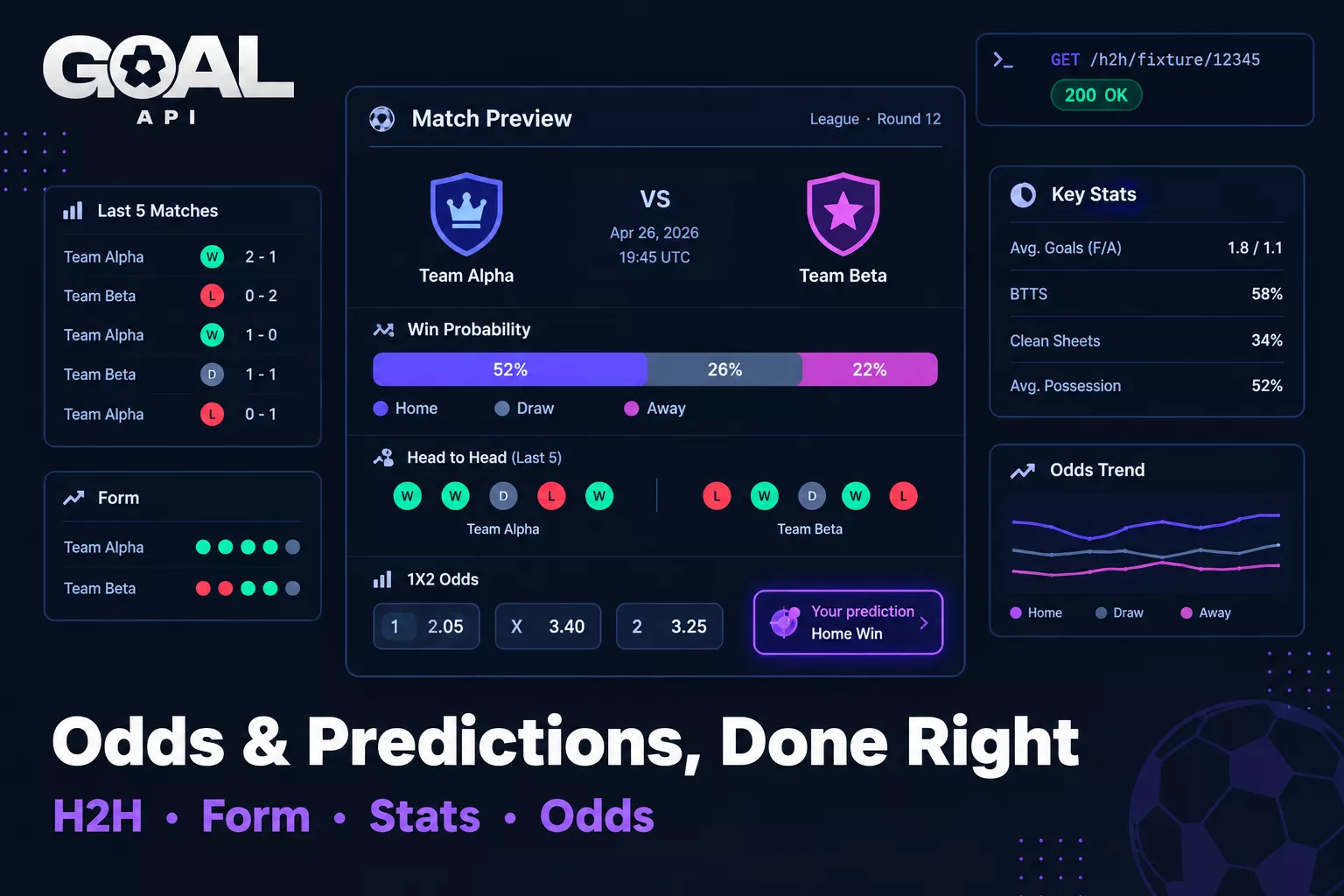
A good pre-match screen answers one question before kickoff: who's likely to win, and why? Betting apps, tipster tools, and fan apps all want the same thing — odds, a prediction, and the evidence behind it. This guide shows how to build that feature on real football data from GOAL API, starting with the signals you can compute yourself and then layering in odds and prediction data.
One honesty note up front, because it saves you debugging time: the prediction and odds data is held per-league (hundreds of competitions carry it), so the first thing to do for your target leagues is confirm availability on the coverage page — covered in Step 5. Everything in Steps 1–4 is computable from endpoints available on every plan.
Get a free API key and check your leagues' coverage: goal-api.com/signup
What a Pre-Match Preview Actually Needs
Strip a betting preview to its parts and you get four inputs:
- History — how these two teams have fared against each other (head-to-head).
- Form — how each team is playing right now (recent results).
- Strength — underlying team and player quality (stats).
- Market & model — the bookmakers' odds and a prediction, where available.
The first three are fully computable from documented endpoints today. The fourth is where odds and prediction data come in. Build the feature so the first three always work, and the fourth enriches it where your leagues have it.
Step 1: The Head-to-Head Record
Start with history. The head-to-head endpoint gives you the historical matchup between two teams — total meetings, wins each way, and aggregate stats.
async function getH2H(team1, team2) {
  const res = await fetch(
    `https://api.goal-api.com/v1/h2h/${team1}/${team2}/stats`,
    { headers: { Authorization: `Bearer ${process.env.GOAL_API_KEY}` } }
  );
  return (await res.json()).data;
}
Endpoints: GET /h2h/:team1Id/:team2Id | /direct | /stats
Step 2: Current Form From the Standings
History matters less than momentum. The standings with form view returns each team's form guide — wins, draws, losses, points per game and a form percentage — so you can weight a team in form above one that isn't.
async function getForm(leagueId) {
  const res = await fetch(
    `https://api.goal-api.com/v1/standings/${leagueId}/form`,
    { headers: { Authorization: `Bearer ${process.env.GOAL_API_KEY}` } }
  );
  return (await res.json()).data;  // standings rows, each with formGuide and formPercentage
}
Endpoint: GET /standings/:leagueId/form
Step 3: Team & Player Strength Signals
Add depth with team statistics and, for a sharper model, key player statistics. A team missing its top scorer is a different proposition — player data lets your preview reflect that.
// One helper for every call below
const get = async (path) => {
  const res = await fetch(`https://api.goal-api.com/v1${path}`, {
    headers: { Authorization: `Bearer ${process.env.GOAL_API_KEY}` },
  });
  return (await res.json()).data;
};

// Team-level strength
const teamStats = await get(`/teams/${teamId}/statistics`);

// Player-level signal (e.g. top scorer form)
const playerStats = await get(`/players/${playerId}/statistics`);

// Recent results for context
const recent = await get(`/results/team/${teamId}`);
Endpoints: GET /teams/:id/statistics | GET /players/:id/statistics | results history via GET /results/team/:teamId
Step 4: Build Your Own Prediction Signal
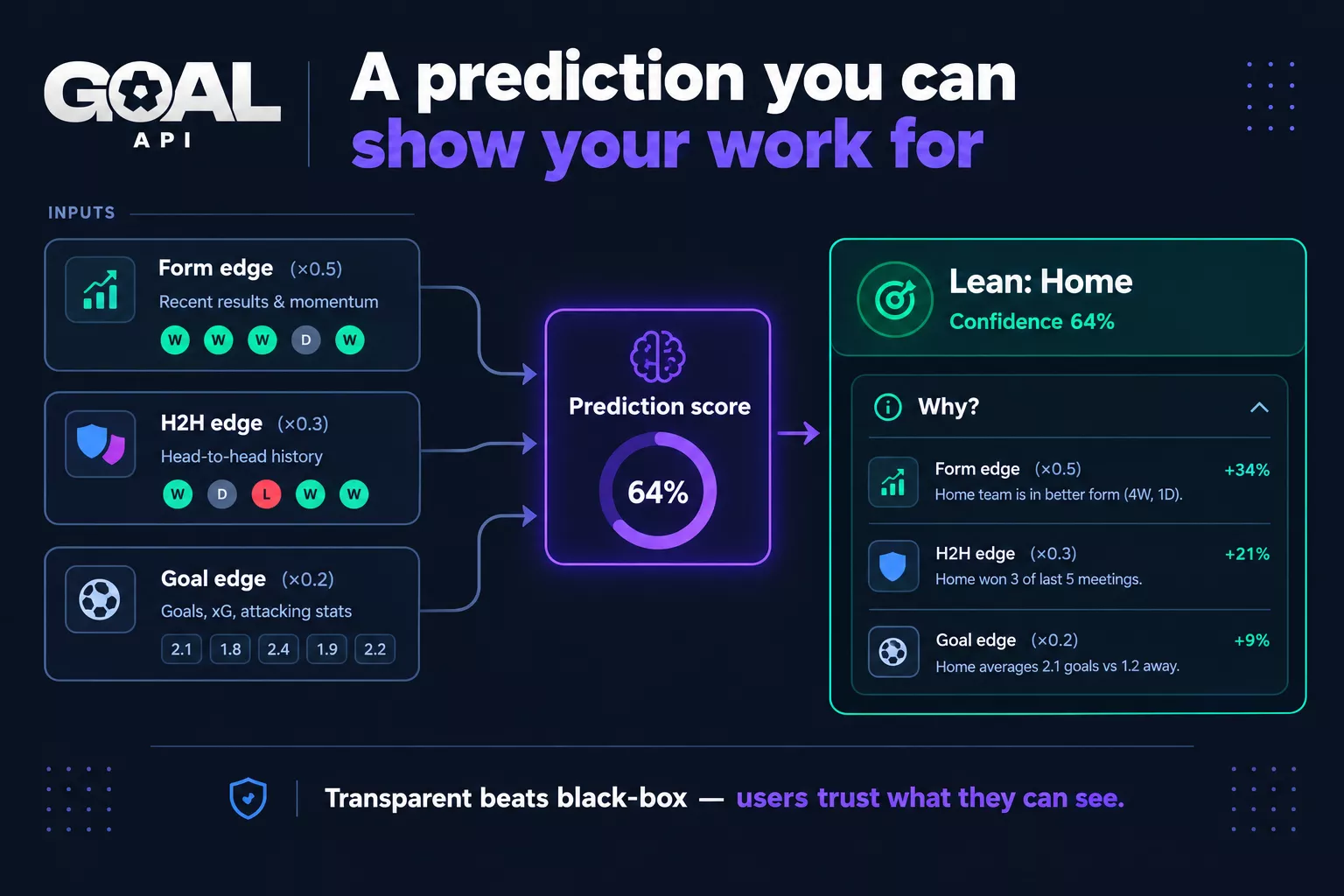
Here's the part worth owning: you don't have to wait for someone else's prediction to ship a useful one. A transparent score built from the data above is often more valuable to users than a black-box number, because you can show the reasoning.
A transparent, explainable score
// A simple, explainable pre-match signal — tune the weights
function predict({ h2h, homeForm, awayForm, homeGoals, awayGoals }) {
  const formEdge = homeForm.points - awayForm.points;  // points from each side's last 10 matches
  const h2hEdge  = h2h.homeWins - h2h.awayWins;
  const goalEdge = homeGoals.avgGoalsScored - awayGoals.avgGoalsScored;

  const score = (formEdge * 0.5) + (h2hEdge * 0.3) + (goalEdge * 0.2);

  return {
    lean: score > 0 ? 'home' : score < 0 ? 'away' : 'even',
    confidence: Math.min(Math.abs(score) / 10, 1),
    // show your work — users trust what they can see
    factors: { formEdge, h2hEdge, goalEdge },
  };
}
An explainable score you control beats an opaque one you don't: you can display the factors, tune the weights for your audience, and never misrepresent a third party's model. Many successful tipster products are exactly this — good data plus a transparent rule set.
Step 5: Layering In Odds & Prediction Data
Bookmaker odds and model predictions turn a preview into a betting product. GOAL API holds this data for a large share of its competitions — but coverage varies by league, so you confirm it per competition before building a feature around it.
Checking odds & prediction availability
The coverage page is the source of truth: it lists, per league, whether Odds and Predictions are held — hundreds of competitions carry odds, and a large set carry predictions. Check your target leagues there first. If the leagues you need have the data and you want to wire it into your app, contact the team to confirm access and the current integration path for your plan.
Don't assume odds or predictions exist for every competition. Check the coverage page for your specific leagues before designing the feature — the same way you'd check whether a league has top scorers or lineups. Designing around data a league doesn't carry is the most common integration mistake.
Where you do have odds, the standard pattern is: store the latest pre-match prices against the fixture, show them beside your own prediction, and flag where your model and the market disagree — that gap is the insight users pay for.
Putting the Preview Together
Assemble the pieces into one preview object per fixture: the h2h summary, both teams' form, your prediction signal, and odds where available. The lineups and visual layout are covered in the build a match page tutorial — a preview is essentially a match page shown before kickoff.
async function buildPreview(fixture) {
  const home = fixture.homeTeamId, away = fixture.awayTeamId;
  const [h2h, form, homeStats, awayStats] = await Promise.all([
    get(`/h2h/${home}/${away}/stats`),
    get(`/standings/${fixture.leagueId}/form`),
    get(`/teams/${home}/statistics`),
    get(`/teams/${away}/statistics`),
  ]);
  // team1/team2 in the h2h response follow the API's order, not the URL's
  const homeIs1 = h2h.teams.team1.id === home;
  const hh = h2h.headToHead;
  const prediction = predict({
    h2h: { homeWins: homeIs1 ? hh.team1Wins : hh.team2Wins, awayWins: homeIs1 ? hh.team2Wins : hh.team1Wins },
    homeForm: h2h.recentForm[homeIs1 ? 'team1' : 'team2'],
    awayForm: h2h.recentForm[homeIs1 ? 'team2' : 'team1'],
    homeGoals: homeStats.overall,
    awayGoals: awayStats.overall,
  });
  return { fixture, h2h, form, prediction /*, odds (where available) */ };
}
Responsible-Betting & Compliance Notes
If your app shows odds or encourages wagering, you're in regulated territory. A few essentials:
- Show responsible-gambling messaging and age gates where your jurisdiction requires them.
- Never present a prediction as a guarantee — label confidence, show the factors, and keep it informational.
- Check the licensing rules for every market you operate in; they differ sharply by country and US state.
- Size your plan for match-day spikes — betting previews cluster around fixtures. The pay per match pricing guide shows how to budget for that.
Endpoints You'll Use
| Endpoint | Role in the preview |
|---|---|
| /h2h/:t1/:t2/stats | Historical matchup |
| /h2h/:t1/:t2/direct | Recent meetings |
| /standings/:leagueId/form | Current form per team |
| /teams/:id/statistics | Team strength |
| /players/:id/statistics | Key player form |
| /results/team/:teamId | Recent results context |
| Coverage page + contact | Confirm & access odds / prediction data per league |
Start building free → | No credit card | Check odds & prediction coverage for your leagues