The API-Football Alternative Developers Switch To
Looking for an API-Football alternative? Here's why developers hit the 100 req/day free tier and once-a-day odds ceiling — and what GOAL API offers instead.


GOAL API
API-Football is one of the most widely used football APIs on the planet, and for good reason. It launched in 2018, covers 1,200+ leagues, and got enormous reach through its distribution on RapidAPI. For a huge number of developers, it's the first football API they ever touch.
But there's a recurring moment in a project's life where developers start searching for an API-Football alternative — and it's almost always triggered by one of four specific walls, not by a vague dissatisfaction. This post names those walls plainly and shows how GOAL API compares against each one.
GOAL API free tier — no credit card, same endpoints as paid plans: goal-api.com/signup
What API-Football Gets Right
Credit where it's due. API-Football's free tier gives you access to every endpoint — fixtures, standings, players, statistics, live scores, odds, transfers — not a stripped-down subset. That's genuinely developer-friendly for learning and prototyping.
Its league coverage is broad, the documentation is comprehensive, and its live scores update on a roughly 15-second interval during matches. It also ships free embeddable widgets for livescores, fixtures, and standings, which is a nice touch for developers who don't want to build frontend components from scratch.
For a prototype, a portfolio project, or an MVP that can live inside the free tier's limits, API-Football is a reasonable starting point. The friction shows up when the project grows.
The Four Walls Developers Hit
1. The Free Tier Is 100 Requests a Day
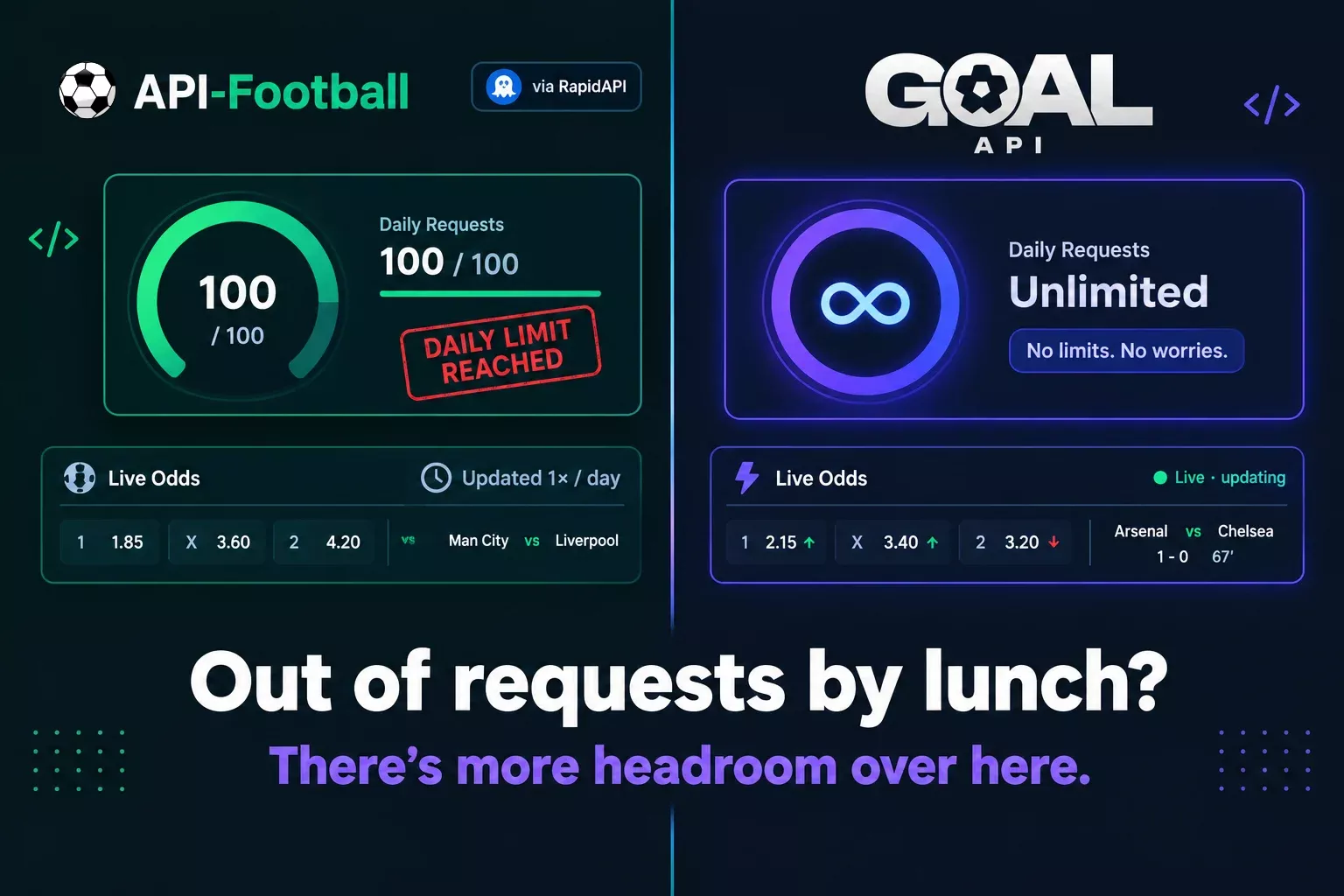
The free tier gives you every endpoint — but only 100 requests per day, resetting at midnight UTC, with a 10-requests-per-minute ceiling on top.
That number sounds workable until you actually build something. A single page that shows today's fixtures, then lets a user click into a match for events and lineups, can burn 5–10 requests per visit. Testing your own integration during development — refreshing, debugging, re-running — eats through 100 requests before lunch. The free tier is enough to confirm the API returns JSON; it is not enough to build against day-to-day without immediately hitting the wall.
The 100-req/day free cap is a testing ceiling, not a build budget. If you're refreshing your own app during development, you'll hit it within a couple of hours.
2. Odds Are Pre-Match Only, Updated Once a Day
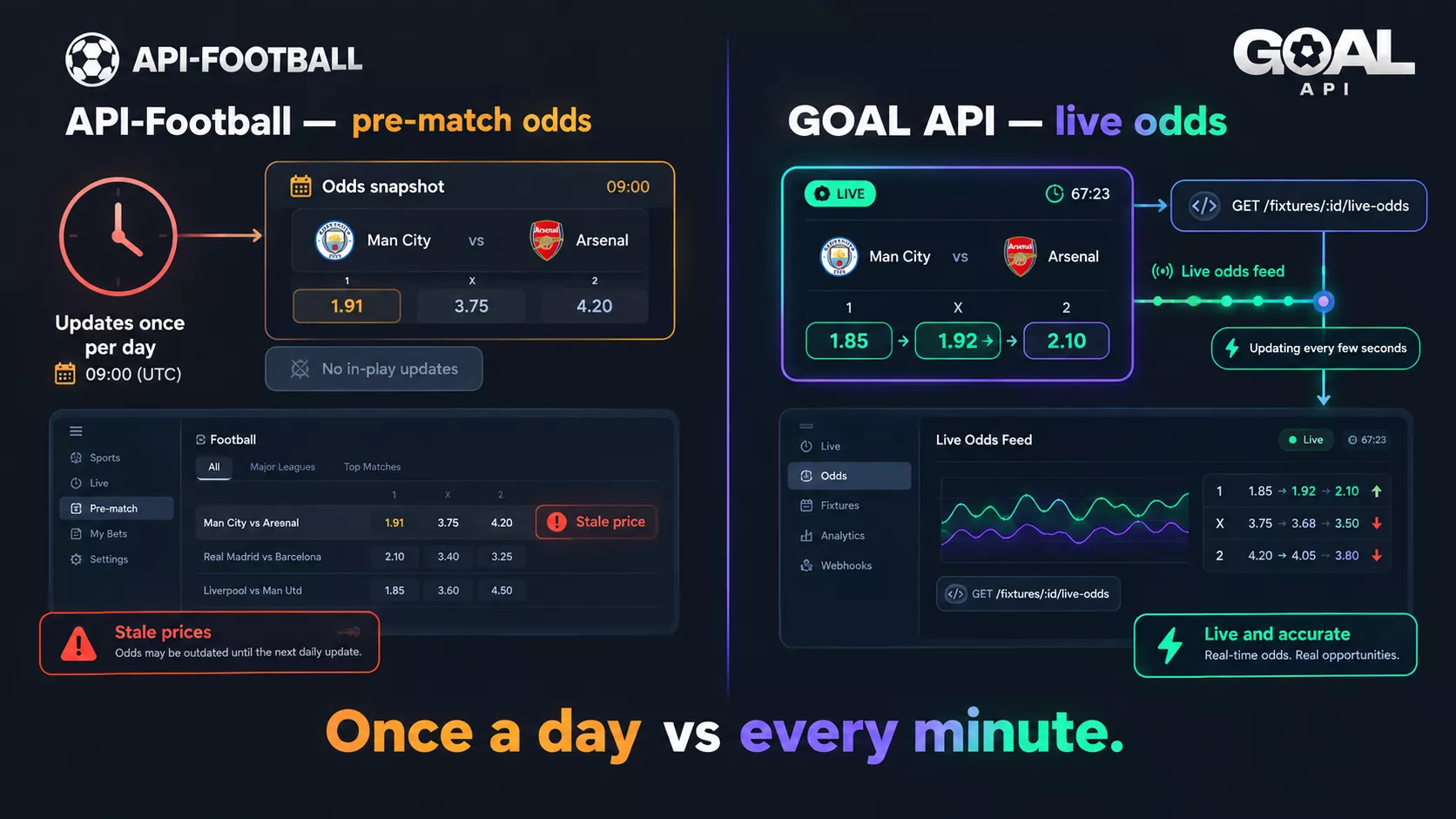
This is the wall that sends betting and in-play developers looking hardest. API-Football's standard odds endpoint is pre-match only, and per its own documentation it's updated roughly once a day, with a recommended one call per day.
That's fine if you just want to show an indicative price next to a fixture. It is not enough if your product's value depends on prices actually moving — line shopping, value detection, arbitrage, or any in-play feature. A once-a-day snapshot can't power a live betting dashboard.
GOAL API separates the two cases: pre-match odds at GET /fixtures/:id/odds and in-play odds at GET /fixtures/:id/live-odds, which updates during the match rather than once a day. For any product where the odds are the product, that difference is the whole ballgame.
3. No WebSocket — Live Means Polling
API-Football is a REST polling API. To track live matches you poll the live endpoint on a timer. During a busy match day with multiple concurrent games, that polling — combined with the per-minute and per-day limits — becomes a real constraint on how many matches you can follow and how fresh your data is.
GOAL API offers a WebSocket connection that pushes score updates and match events the instant they happen, so you hold one connection instead of firing repeated polls. The post comparing polling vs WebSocket vs webhooks runs the concrete request math — on a busy Saturday the difference between the two approaches is thousands of requests versus a single connection.
4. The RapidAPI Middleman Layer
A large share of API-Football usage runs through RapidAPI. That distribution is part of why it got so popular — but it also means an extra layer between you and the data: RapidAPI's own account, billing, and rate-limit handling sit on top of the API itself. Some teams are fine with that. Others want a direct relationship with the data provider, with billing and limits they control in one place.
GOAL API is accessed directly — one account, one dashboard, one set of rate-limit headers on every response. No third-party marketplace layer to reason about when something breaks.
GOAL API: Where It's Different
GOAL API addresses the four walls above directly:
Usable request volume. The free tier exposes the same endpoints as paid plans, so you can build and evaluate a real integration rather than rationing 100 requests a day.
Live in-play odds. GET /fixtures/:id/live-odds updates during the match — not a once-a-day pre-match snapshot.
WebSocket and webhooks. Real-time events via a persistent connection, or webhook push to your server — no polling loop required for live data.
Direct access. No RapidAPI layer. League coverage is listed on the coverage page.
Side-by-Side: API-Football vs GOAL API
| API-Football | GOAL API | |
|---|---|---|
| Free tier | 100 requests/day, all endpoints | Free tier — same endpoints as paid |
| Access model | Direct + RapidAPI marketplace | Direct only |
| Live event delivery | REST polling (~15s updates) | WebSocket push + webhooks |
| Pre-match odds | Included | GET /fixtures/:id/odds |
| In-play / live odds | Not in standard odds endpoint | GET /fixtures/:id/live-odds |
| Live scores | GET /fixtures?live=all | GET /fixtures/live |
| Standings | GET /standings | GET /standings/:leagueId |
| Player stats | GET /players | GET /players/:id/statistics |
| Head-to-head | GET /fixtures/headtohead | GET /h2h/:team1Id/:team2Id |
| WebSocket | No | Yes — wss://api.goal-api.com/ws |
| Webhook push | No | Yes — goal.scored, match.started, etc. |
| Embeddable widgets | Yes | Yes — match, league table, fixtures, top scorers and match stats |
Note: both ship drop-in frontend components. GOAL API's widget builder, in the dashboard, covers a match scoreboard, league table, fixtures list, top scorers and match statistics; beyond those you build the UI from the API. Weigh that against the real-time and odds differences for your use case.
Switching From API-Football: Endpoint Map
Both are standard REST with Bearer tokens and JSON. The concepts map directly:
| What you need | API-Football | GOAL API |
|---|---|---|
| Live scores | GET /fixtures?live=all | GET /fixtures/live |
| Fixtures by date | GET /fixtures?date={date} | GET /fixtures/date/:date |
| League standings | GET /standings?league={id}&season={y} | GET /standings/:leagueId |
| Match events | GET /fixtures/events?fixture={id} | GET /fixtures/:id/events |
| Lineups | GET /fixtures/lineups?fixture={id} | GET /fixtures/:id/lineups |
| Player stats | GET /players?id={id}&season={y} | GET /players/:id/statistics |
| Head-to-head | GET /fixtures/headtohead?h2h={a}-{b} | GET /h2h/:team1Id/:team2Id |
| Pre-match odds | GET /odds?fixture={id} | GET /fixtures/:id/odds |
| Live odds | (not available live) | GET /fixtures/:id/live-odds |
| Top scorers | GET /players/topscorers?league={id} | GET /leagues/:id/top-scorers |
Response shape differences
API-Football wraps everything in { response: [...], paging: {...} }. GOAL API uses { success: true, data: {...} }. The outer key differs; the core entity fields are similar enough that a thin translation layer handles it. Wrap the API behind your own service interface with your own Match, Team, and Player types — then only that layer changes if you ever switch again.
// Abstraction pattern — swap providers by changing one file
// apis/football.js
export async function getLiveScores() {
  const res = await fetch('https://api.goal-api.com/v1/fixtures/live', {
    headers: { Authorization: `Bearer ${process.env.GOAL_API_KEY}` },
  });
  const { data } = await res.json();
  // Translate GOAL API shape -> your own Match type here
  return data.map(toMatch);
}
Who Should Switch and Who Shouldn't
Switch to GOAL API if:
- You've outgrown the 100 req/day free cap and want to build against real volume
- Your product needs live, in-play odds — not a once-a-day pre-match snapshot
- You're tracking multiple live matches and polling is straining your limits
- You want a direct provider relationship without the RapidAPI layer
- You want webhook or WebSocket push instead of maintaining polling loops
Stay on API-Football if:
- You rely on an API-Football widget that GOAL API's widget builder doesn't offer
- Your project fits inside the free-tier limits and you only need pre-match data
- You're already deeply integrated via RapidAPI and that billing model suits you
The deciding question is usually: does your product depend on live data — in-play odds, real-time scores at scale — or is a periodic pre-match snapshot enough? If it's the former, switching before you're locked into polling patterns is faster than switching after.
Try GOAL API free → | No credit card | Same endpoints as every paid plan