The RapidAPI Football API Alternative Developers Switch to for Reliability
Pulling football data through RapidAPI means a marketplace sits between you and the vendor. Here's why teams go direct to GOAL API for reliability and clear billing.


GOAL API
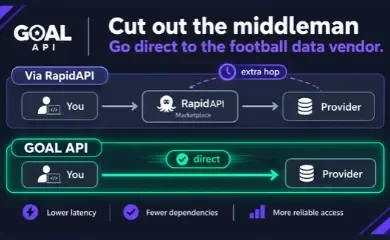
If you're pulling football data through RapidAPI, you've probably noticed something: you're not really a customer of the API you're using — you're a customer of the marketplace in front of it. That's fine while you're prototyping. It starts to matter when you're in production and a match-day spike, a surprise invoice, or an outage you can't explain lands on your desk.
This post explains what "RapidAPI football" actually is, where the middleman quietly costs you, and why a lot of teams eventually go direct to a vendor like GOAL API. It's an honest take — RapidAPI is genuinely useful for some things, and this says so.
First, What "RapidAPI Football" Actually Is
RapidAPI (now "Rapid") is an API marketplace — a directory where thousands of APIs are listed behind a single account and gateway. It doesn't produce football data itself. When you call a "RapidAPI football API," you're calling a third-party provider — most often API-Football — through RapidAPI's proxy, authenticated with an X-RapidAPI-Key and X-RapidAPI-Host header.
So there are always two companies between you and the data: the provider that collects it, and the marketplace that resells access to it. That layering is the whole story of this article.
The Hidden Cost of the Middleman
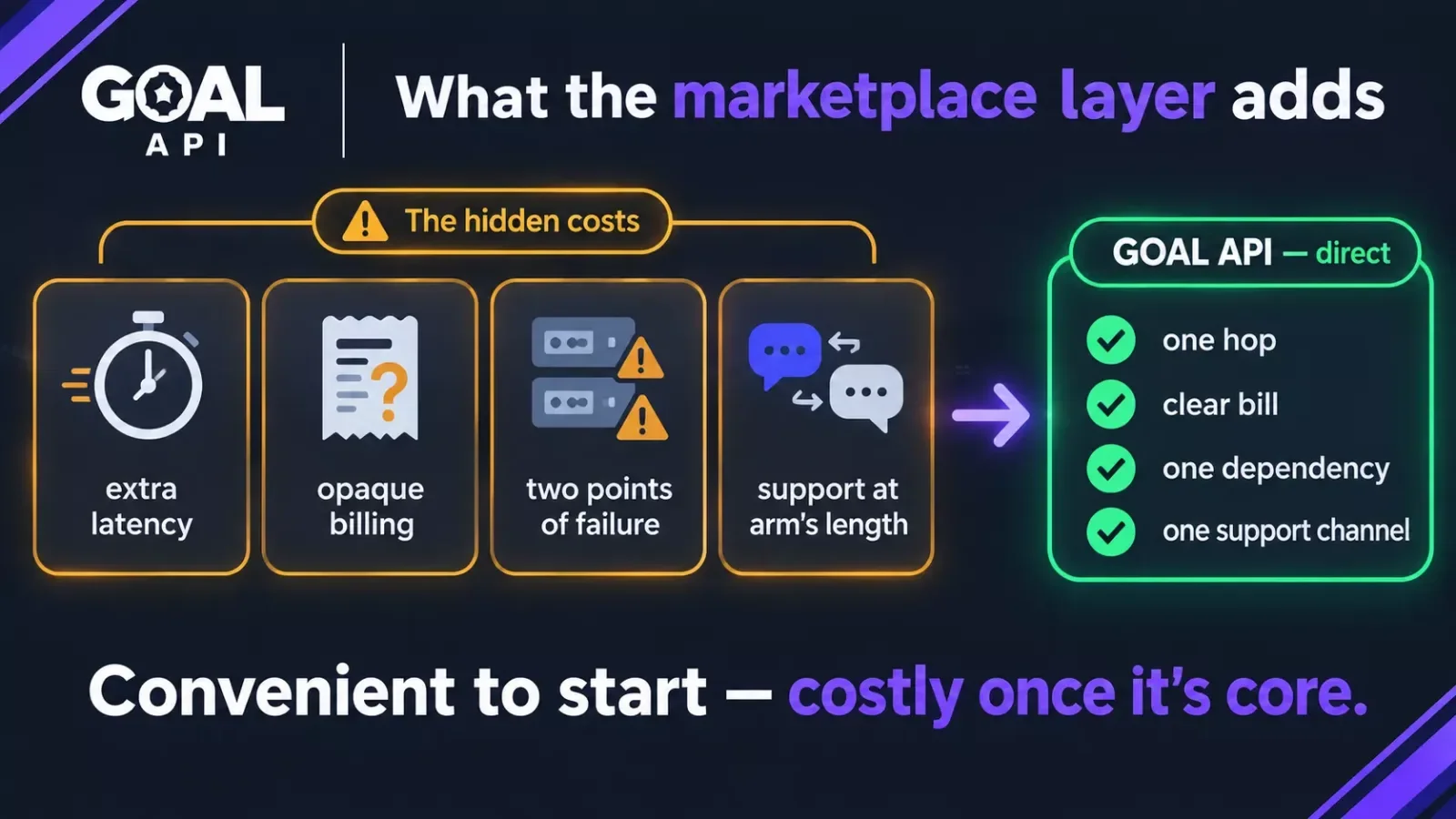
1. An Extra Hop on Every Request
Every call goes you → RapidAPI → the provider → back. The gateway has to authenticate, meter, and forward each request, which adds latency you don't control and can't tune. For a static lookup it's invisible; for a live scoreboard refreshing every few seconds, that extra hop is overhead on every single call.
2. Billing You Don't Fully Control
On a marketplace, the marketplace owns the meter. Quotas, overage charges and the price you pay are set in its listing, not by the vendor, and marketplace pricing can carry a markup over going direct. When usage spikes, the surprise shows up on the marketplace invoice — and you're reconciling it with a party that didn't generate the data. Direct billing, like GOAL API's pay-per-match pricing, is something you can read and predict.
3. Two Dependencies, Two Points of Failure
Going through a marketplace means two things can break instead of one. If the provider has an incident, you're down. If the marketplace gateway has an incident, you're also down — even when the provider is perfectly healthy. You've doubled your surface area for outages, and when something fails, it's not always obvious which layer to blame.
4. Support at Arm's Length
When data looks wrong or a limit bites, who do you ask? The marketplace points at the provider; the provider points at the marketplace. You're relaying messages between two companies instead of talking to the team that actually runs the API. Going direct collapses that into one support channel.
When RapidAPI Is Actually the Right Call
Credit where it's due — the marketplace model is genuinely good at a few things, and if these describe you, there's no rush to leave:
- Discovery. Browsing and comparing many APIs in one place is easier than hunting down vendors individually.
- Trying lots of APIs fast. One key and one console to test a dozen APIs is convenient for early experimentation.
- One invoice across many APIs. If you deliberately consume several unrelated APIs through the marketplace, a single bill has real appeal.
The calculus changes once one of those APIs becomes core to your product. At that point the convenience is doing less for you, and the middleman is doing more to you.
GOAL API: Direct to the Vendor
GOAL API (see the documentation) is the API and the vendor — no marketplace in between:
- One hop, not two. You call
https://api.goal-api.com/v1directly with a Bearer token. No gateway in the path to meter and forward every request. - 1,000+ competitions. Top divisions, lower leagues, cups and internationals — the coverage page lists every one and what's held for it.
- Real-time, pushed to you. Live scores over WebSocket and webhooks — a live scores over WebSocket connection instead of hammering a proxied endpoint on a timer.
- Billing you can read. Direct, predictable pricing with a free tier and no credit card, so you're not decoding a marketplace meter. The full data depth — stats, lineups, events — is covered in the Football Stats API post.
Side-by-Side: RapidAPI vs Going Direct
| Football API via RapidAPI | GOAL API (direct) | |
|---|---|---|
| What it is | Marketplace / proxy | The vendor itself |
| Request path | You → proxy → provider | You → provider |
| Auth | X-RapidAPI-Key + Host | Authorization: Bearer |
| Billing set by | Marketplace listing | The vendor, directly |
| Points of failure | Marketplace + provider | Provider only |
| Support | Relayed between two parties | One channel |
| Real-time | Depends on provider, via proxy | WebSocket + webhooks, direct |
| Free tier | Per listing | Free, no credit card |
| Best for | Discovery, trying many APIs | A football API core to your product |
RapidAPI listing details vary by provider and change over time — verify current limits and pricing on the listing you use. GOAL API's direct plans are on the pricing page.
Migrating Off the Marketplace
Going direct is mostly a request-layer change. The data concepts map one-to-one; what changes is the host and the auth header:
| What you need | Via RapidAPI (proxy) | GOAL API (direct) |
|---|---|---|
| Base host | *.p.rapidapi.com |
api.goal-api.com/v1 |
| Auth | X-RapidAPI-Key / X-RapidAPI-Host |
Authorization: Bearer |
| Fixtures / results | provider's /fixtures route | GET /leagues/:id/fixtures |
| Standings | provider's /standings route | GET /standings/:leagueId |
| Live / today | provider's live route | GET /fixtures/live |
| Head-to-head | provider's h2h route | GET /h2h/:t1/:t2 |
The practical difference is two headers becoming one. Wrap the call in your own service layer and it's the only place that changes:
// Before — through the marketplace
fetch('https://football.p.rapidapi.com/fixtures?live=all', {
  headers: {
    'X-RapidAPI-Key': process.env.RAPIDAPI_KEY,
    'X-RapidAPI-Host': 'football.p.rapidapi.com',
  },
});

// After — direct to GOAL API
fetch('https://api.goal-api.com/v1/fixtures/live', {
  headers: { Authorization: `Bearer ${process.env.GOAL_API_KEY}` },
});
Endpoint paths are illustrative — check the documentation for exact routes and response fields. GOAL API wraps responses in { success: true, data: ... } with a pagination object on lists.
Who Should Switch
Stay on RapidAPI if:
- You're still in discovery, testing several APIs with one key.
- You deliberately consume many unrelated APIs and want one invoice.
- Football data is a minor, non-critical part of what you're building.
Go direct to GOAL API if:
- A football API has become core to your product and needs to be reliable.
- You want one dependency, one bill and one support channel — not two of each.
- You need real-time over WebSocket or webhooks without a proxy in the path.
- You want billing you can actually read and forecast.
Comparing the whole field? The best football API comparison and the 5 football data APIs compared piece lay it out, and the pricing page shows where the direct plans sit. If you're specifically on API-Football via the marketplace, the API-Football alternative post is the direct follow-on.
FAQ
Is RapidAPI a football API? No. RapidAPI (now Rapid) is an API marketplace, not a data provider. The football data you get through it comes from third-party APIs listed on the marketplace, most often API-Football. You're calling that provider through RapidAPI's gateway, which adds a layer between you and the vendor.
Why do developers move off RapidAPI to a direct football API? Reliability and billing clarity: the marketplace adds a proxy hop and a second point of failure, quotas and invoices are managed by the marketplace rather than the vendor, and support is at arm's length. Going direct removes the middleman — one API, one bill, one support channel.
What's the best RapidAPI football API alternative? A direct football data API. GOAL API gives you live scores, fixtures, standings, lineups, events, player and team stats and head-to-head across 1,000+ competitions, over REST plus WebSocket and webhooks, billed directly with a free tier and no credit card.
How hard is it to migrate? Mostly a change of base URL and auth header. Instead of the marketplace host with X-RapidAPI-Key and X-RapidAPI-Host, you call the vendor directly with an Authorization: Bearer token. The resource concepts map directly, so the main work is updating the request layer.
Go direct → goal-api.com/signup — no credit card, one API, one bill, one support channel.