The #1 Sportmonks Football API Alternative for 2026
Looking for a Sportmonks football API alternative? Here's why developers leave Sportmonks, what they switch to, and how GOAL API compares on price, endpoints, and real-time data.


GOAL API
Sportmonks has been in the football API space since 2016. It has real depth — 2,200+ leagues, an includes system that lets you compose responses exactly how you want them, and SDKs in seven languages. For a certain kind of project, it is genuinely the right tool.
But there is a clear pattern in developer forums and migration threads: teams sign up for Sportmonks, spend two or three months building on it, then start looking for an exit. Not because the data is bad, but because the billing model and the integration complexity grind them down before they ship.
This post explains exactly what drives that exit — and how GOAL API compares as an alternative for developers who want live scores, standings, player stats, odds, and real-time events without the overhead.
No credit card required to try GOAL API: goal-api.com/signup
What Sportmonks Gets Right
To be fair about this: Sportmonks earns its reputation in a few specific areas.
The data depth is real. Lineups, formations, referee stats, coach stats, ball coordinate tracking, expected goals, pressure index — it is one of the deepest football-specific datasets you can buy. If you are building a professional analytics product and need data fields that most APIs don't even try to collect, Sportmonks has them.
The includes system is genuinely clever once you understand it. You can compose a single request that returns a fixture with its lineups, player details, events, statistics, and xG in one response. For bandwidth-constrained applications, that composability is a real advantage.
And the track record matters for enterprise buyers — 10 years, 30,000+ developers, 99.99% uptime SLA. That kind of history is hard for a newer provider to match.
The Three Things That Drive Developers Away
Despite the above, there are three recurring pain points that send developers searching for alternatives:
1. Pricing That Scales the Wrong Way
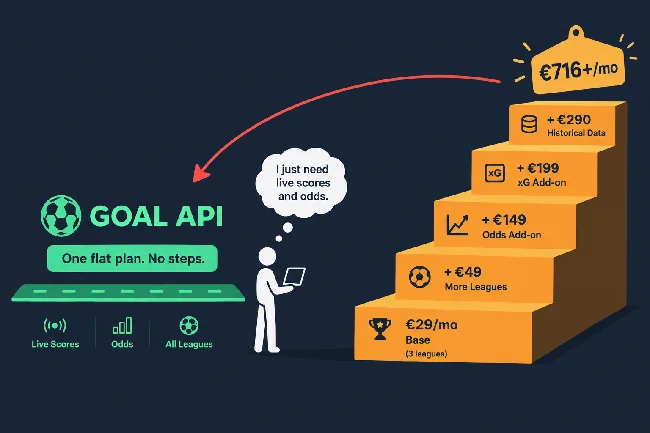
Sportmonks' entry price of €29/month looks reasonable until you start adding the things you actually need for a real product.
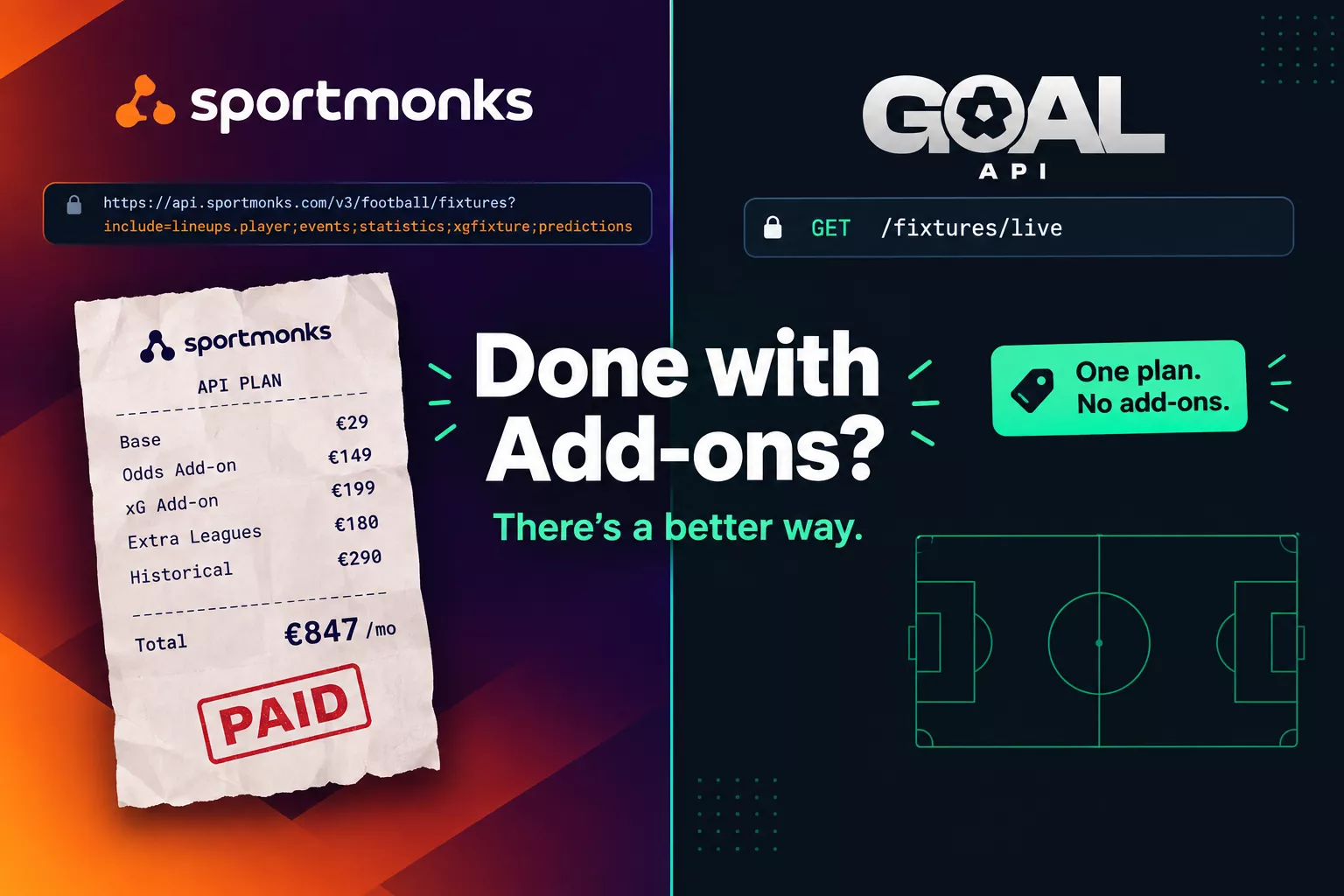
The base plan gives you a set number of leagues. Want more leagues? That's a tier upgrade. Want odds? Add-on. Want xG metrics? Add-on — and the xG add-on alone starts at €24/month but meaningful coverage across a useful set of leagues runs up to €300/month for that feature alone. Historical data beyond three seasons, premium bookmaker coverage, and a news feed all follow the same pattern.
Developers building production apps consistently report monthly bills of €600–€1,000+ once they have stacked the add-ons needed to get a complete dataset. The €29 entry price is effectively a demo tier for serious products.
The headline entry price on Sportmonks is not what you will pay once you need odds, xG, more than 5 leagues, and historical depth. Stack the add-ons before committing and calculate the real number.
2. The Includes System Has a Real Learning Curve
The includes system is powerful, but it is not standard REST. Instead of calling GET /fixtures/123/events, you call GET /fixtures/123?include=events;lineups.player;statistics and chain what you need with semicolons.
Each include carries a complexity score, and requests that exceed the threshold fail. Sportmonks' own documentation lists query-too-complex timeouts as a common error for new developers. You're not just learning an API — you're learning a query language specific to Sportmonks.
For a solo developer or a small team shipping fast, this adds a week or two of orientation time before you're writing business logic. For a team that has to maintain the integration, it becomes permanent cognitive overhead.
// Sportmonks: chain includes with semicolons, stay under complexity budget

GET /v3/football/fixtures/123
  ?include=lineups.player;events;statistics;xgfixture;predictions
  &api_token=YOUR_TOKEN

// If the complexity budget is exceeded, you get a 429 or a timeout.
// You have to tune includes until the request fits the budget.
Standard REST APIs don't work like this. Most developers expect a flat endpoint per resource — which is why the includes system requires unlearning habits before you can use it productively.
3. REST-Only, No WebSocket
Sportmonks is a polling API. There is no WebSocket, no Server-Sent Events, and no webhook push for live match events.
That means tracking 10 live matches simultaneously — a normal Saturday afternoon in any football app — requires polling each fixture every 10 seconds, per Sportmonks' own recommendation. That's 360 requests per fixture per hour, times 10 matches, times the duration of the games. On a busy match day you can burn through a day's rate limit budget in a few hours.
For any product where latency matters — a goal alert, a live scoreboard, a betting dashboard — you end up building a caching and polling infrastructure on top of the API rather than being able to consume events as they happen. The blog post comparing polling vs WebSocket vs webhooks shows the request math on a concrete example.
GOAL API: What's Different
GOAL API is built on three design decisions that directly address the above:
Flat endpoint structure. Every resource is its own URL. Live scores: GET /fixtures/live. Match events: GET /fixtures/:id/events. Head-to-head stats: GET /h2h/:team1Id/:team2Id/stats. No includes, no complexity budgets, no chaining. A developer who has used any REST API is productive in minutes, not days.
WebSocket and webhooks included. A persistent WebSocket connection delivers goal alerts, score updates, and match events the instant they happen — no polling loop required. Webhook endpoints let you register a URL and receive goal.scored or match.started events as POST requests to your server. See the full transport documentation. For live score dashboard latency, this is the difference between a 30-second polling delay and a sub-second push.
No add-on system. Odds, player stats, head-to-head data, standings, and lineups are all included in every paid plan — nothing is priced separately. The free tier has every endpoint except odds and predictions. League coverage is listed on the coverage page — what you see is what you get, without a tier matrix to navigate.
Side-by-Side: Sportmonks vs GOAL API
| Sportmonks | GOAL API | |
|---|---|---|
| Pricing model | League-based tiers + add-ons | Flat plans, no add-ons |
| Entry price | €29/mo (limited leagues) | Free tier available |
| Full-featured cost | €600–€1,000+/mo with all add-ons | Single plan covers live scores, odds, stats |
| Request pattern | REST + includes system | Standard REST — one URL per resource |
| Live event delivery | Polling (10-second recommended interval) | WebSocket push + webhooks |
| Odds data | Add-on (priced separately per tier) | Included in every paid plan: GET /fixtures/:id/odds |
| Player stats | Included in most plans | Included: GET /players/:id/statistics |
| Head-to-head | Included | Included: GET /h2h/:id/:id/stats |
| xG / advanced metrics | Add-on (€24–€300/mo) | Not offered |
| Free trial | Free tier: Danish Superliga + Scottish Prem only | Free tier — every endpoint except odds and predictions, all leagues |
| WebSocket | No | Yes — wss://api.goal-api.com/ws |
| Webhook push | No | Yes — goal.scored, match.started, etc. |
| SDK languages | 7 official SDKs | JavaScript, Python, PHP, Go, Dart/Flutter |
| Docs complexity | High — includes system, entity rate limits | Low — standard REST, one page per endpoint |
Switching From Sportmonks: What Changes
Endpoint mapping
The core data shapes map cleanly. Here are the direct equivalents:
| What you need | Sportmonks endpoint | GOAL API endpoint |
|---|---|---|
| Live scores | GET /v3/football/livescores/inplay |
GET /fixtures/live |
| Fixtures by date | GET /v3/football/fixtures/date/{date} |
GET /fixtures/date/:date |
| League table | GET /v3/football/standings/seasons/{id} |
GET /standings/:leagueId |
| Match events | GET /v3/football/fixtures/{id}?include=events |
GET /fixtures/:id/events |
| Player stats | GET /v3/football/players/{id}?include=statistics |
GET /players/:id/statistics |
| Head-to-head | GET /v3/football/fixtures/head-to-head/{t1}/{t2} |
GET /h2h/:team1Id/:team2Id |
| Pre-match odds | GET /v3/football/odds/fixtures/{id} |
GET /fixtures/:id/odds |
| Live odds | GET /v3/football/odds/inplay/fixtures/{id} |
GET /fixtures/:id/live-odds |
Response shape
Sportmonks wraps all responses in { data: { ... }, pagination: { ... } }. GOAL API follows the same envelope: { success: true, data: {...} }. The top-level key changes but the nesting depth is similar. Most migration work is updating endpoint URLs and removing includes parameters — not restructuring your data model.
Wrap GOAL API calls behind a service abstraction layer from day one. Define your own Match, Team, and Player types and translate from the API shape in one place. That way, if you ever need to change providers again, only the translation layer changes.
The Verdict
If you need the absolute deepest football data available — ball coordinates, referee career stats, pressure index — and you have the budget and the patience for the includes system, Sportmonks is one of the few providers that actually has that data.
For the other 90% of football apps — live scoreboards, fan dashboards, betting tools, fantasy platforms, match preview pages — the includes complexity and the add-on billing model add cost and friction without adding proportional value.
GOAL API covers the same core use cases — live scores, standings, player stats, head-to-head, odds, events — without an includes system to learn or a billing model that escalates as you add features. The WebSocket transport means you're not burning rate-limit buckets on polling loops during live matches. And the free tier gives you every endpoint except odds and predictions, on the same infrastructure as the paid plans, so you can validate the integration before committing.
Try GOAL API free → goal-api.com/signup | No credit card | Same API, same speed as every paid plan