The Truth About TheStatsAPI & Its Better Alternatives
Looking for a TheStatsAPI alternative? This post covers exactly where TheStatsAPI falls short — coverage, support, WebSocket — and how GOAL API compares for production football apps.


GOAL API
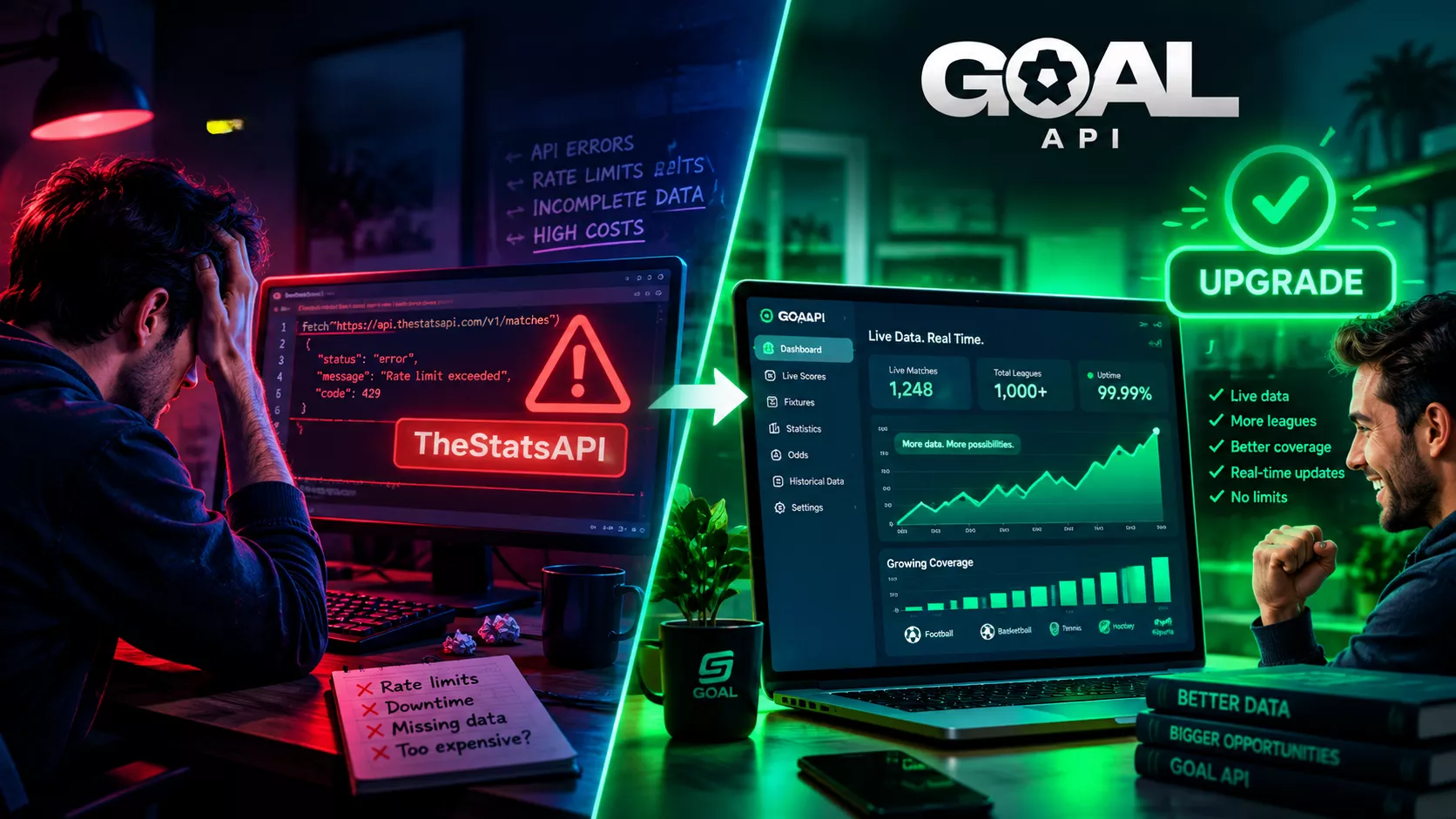
TheStatsAPI launched as a flat-rate, stats-first football API and positioned itself well: $50 a month, xG and odds included from day one, no add-on matrix to navigate. For developers who had come from Sportmonks and were exhausted by league tiers and feature add-ons, the pitch was compelling.
It's a credible product. But there's a reason developers search for TheStatsAPI alternatives, and it's not because the data is bad. It's because a handful of specific constraints hit at exactly the moment a project starts to grow — and those constraints are architectural, not something a plan upgrade fixes.
This post walks through those constraints and shows you a better alternative option.
What TheStatsAPI Gets Right
TheStatsAPI's strongest selling point is what it doesn't do: it doesn't have an add-on system. xG, npxG, expected assists, and bookmaker odds from five bookmakers are included on every plan. That's a genuine differentiator versus Sportmonks, where each of those features carries its own pricing tier.
The documentation is clean and follows standard REST conventions — standard JSON, a Bearer token, one resource per endpoint. A developer coming from any other REST API can read the docs and make a working request in under 10 minutes.
And for projects focused on the major European leagues — Premier League, La Liga, Champions League, Serie A, Bundesliga — the data quality is good and the 10 years of historical depth is a real asset for analytics use cases.
For a certain scope of project, TheStatsAPI is the right choice. But that scope has edges that developers run into.
The Four Friction Points Developers Hit
1. 150 Leagues Is the Ceiling (And It's a Hard One)
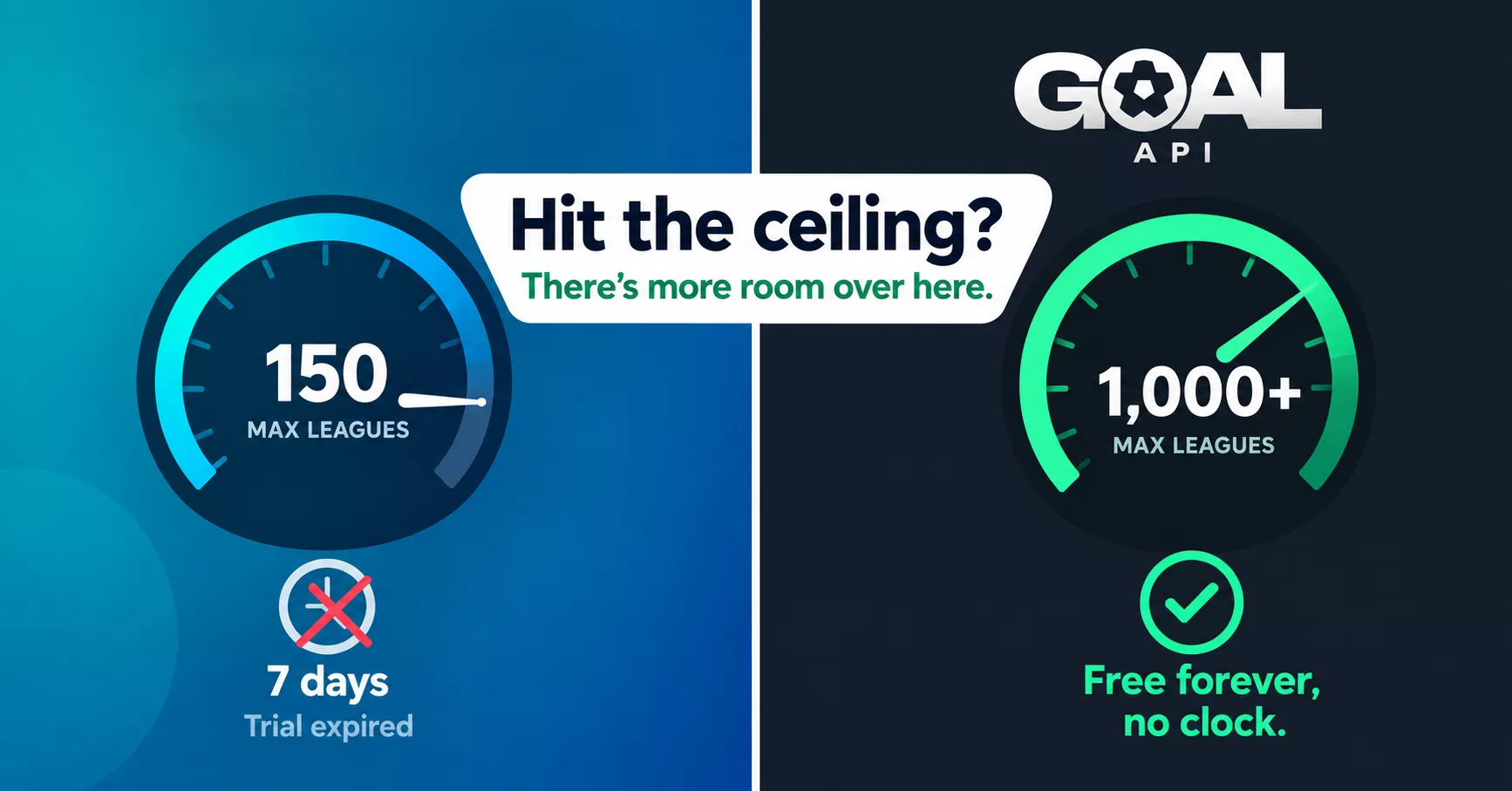
TheStatsAPI's Starter plan covers 80 competitions. The documentation mentions up to 1,196 competitions available on request, but that 'on request' is key — it's not self-serve, and the standard plan you're paying $50/month for covers 150 competitions maximum.
For a project building around the five major European leagues, 150 is plenty. But most football apps don't stay inside that fence for long. A user base that starts with Premier League fans quickly wants the Championship. A market expansion from UK to Brazil means you need Série A. An analytics product covering South American football needs CONMEBOL competitions that aren't in the standard tier.
When you hit that ceiling, the path forward is either a custom arrangement with TheStatsAPI (which adds sales friction and unpredictable pricing) or switching providers entirely. Most teams end up at the latter.
If your roadmap includes any competitions outside the major European leagues within the next 12 months, verify that TheStatsAPI covers them on your plan tier before integrating.
2. The 7-Day Trial Isn't Enough Time for a Real Evaluation
TheStatsAPI offers a 7-day free trial. That sounds generous until you think about what a real production evaluation requires: setting up the integration, writing your abstraction layer, testing edge cases (what happens at half-time? how does the data behave in the final minute of added time?), and validating that the leagues you need have the data completeness you expect.
Seven days is enough time to confirm an API returns JSON. It's not enough time to validate whether the player IDs are stable across seasons, whether the odds data updates at the frequency your product needs, or whether the historical data coverage for your target leagues is complete enough for the model you're building.
A free tier that doesn't expire — even if it's rate-limited — is more useful for a real technical evaluation than a trial that resets the clock on day one.
3. No WebSocket or Push Transport
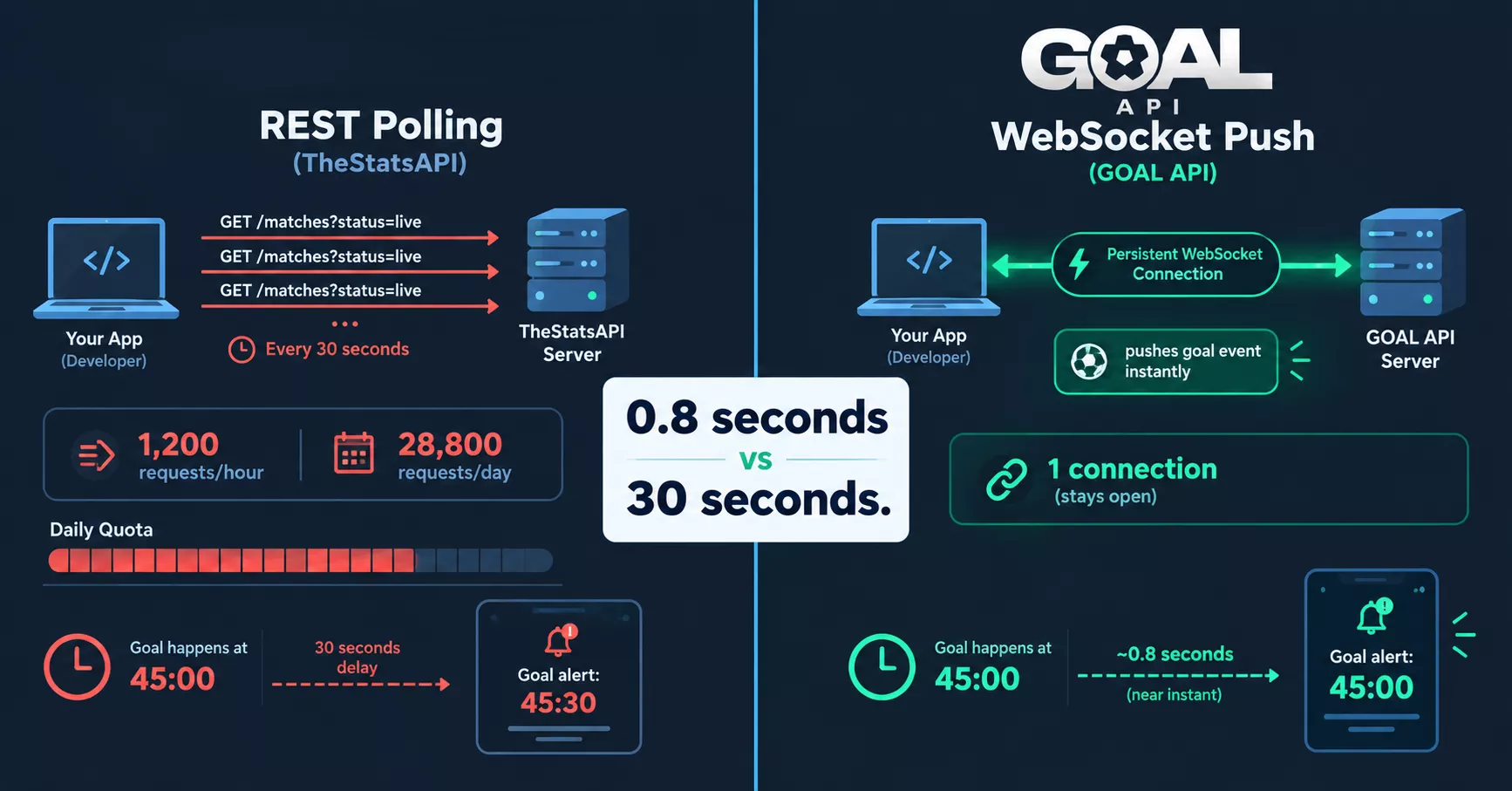
TheStatsAPI is a REST polling API. There is no WebSocket endpoint, no webhook registration, and no Server-Sent Events. For live match data, you poll.
The practical impact: if you're tracking 10 live matches on a Saturday afternoon and polling each every 30 seconds, that's 1,200 requests per hour just for score updates — before you add lineups, statistics, or events. On a busy match day with the full Premier League, Champions League, and La Liga fixtures running simultaneously, a polling architecture burns through daily quota fast.
Polling vs WebSocket vs webhooks → shows the full request math.
The summary version: polling 20 concurrent matches at 10-second intervals costs approximately 43,200 requests per match day. A WebSocket subscription costs one connection and delivers every update instantly.
For a live scoreboard or a goal alert feature, the architectural difference matters. Polling means your users see a goal 0–30 seconds after it happens. A WebSocket push means they see it in under a second.
4. Email-Only Support Is Slow When a Match Is Live
TheStatsAPI's support channel is email. That's a reasonable choice for most API companies at that price point. But the timing mismatch is real: football data problems happen during matches — which means evenings and weekends, when email support queues are slowest.
If a rate limit kicks in unexpectedly during the Champions League final, or a player ID stops resolving halfway through a match your app is covering, an email ticket that takes 24 hours to get a response isn't useful. That's not a knock on TheStatsAPI specifically — it's a structural constraint of email-only support for a live-data product.
GOAL API: Where It Fills the Gaps
GOAL API covers the same core data set — live scores, standings, player stats, odds, head-to-head records — with three specific differences that address the friction points above.
1,000+ leagues, self-serve. League coverage is listed on the coverage page and is available on your plan without a custom arrangement. South American leagues, Asian leagues, lower English divisions — accessible from the same plan as the Premier League.
No expiry on the free tier. The GOAL API free tier doesn't have a 7-day clock. You can evaluate the integration properly — test edge cases, validate data completeness for your leagues, build your abstraction layer — before committing to a paid plan. Every endpoint except odds and predictions is available on the free tier, on the same infrastructure as the paid plans.
WebSocket and webhooks. A persistent WebSocket connection delivers a match_update message whenever a subscribed match's score, status, goalscorers or cards change — without polling. The WebSocket documentation covers the connection, authentication, and subscription model. Webhook endpoints — goal.scored, score.changed, match.started, match.finished, match.status_changed — are available for apps that prefer a push model over a persistent connection. The live scores WebSocket tutorial walks through a full implementation.
Side-by-Side: TheStatsAPI vs GOAL API
| TheStatsAPI | GOAL API | |
|---|---|---|
| Entry price | $50/mo (7-day trial) | Free tier — no expiry, no card |
| League coverage | 150 standard (up to 1,196 on request) | 1,000+ self-serve |
| Free tier | 7-day trial only | Permanent free tier |
| Request pattern | REST polling only | REST + WebSocket + webhooks |
| Live event delivery | Polling (you set the interval) | WebSocket push — sub-second latency |
| xG / advanced metrics | Included on all plans | Not offered |
| Odds data | 5 bookmakers included | GET /fixtures/:id/odds — 20 bookmakers, on every paid plan |
| Player stats | Included | GET /players/:id/statistics |
| Head-to-head | Available | GET /h2h/:team1Id/:team2Id/stats |
| Historical depth | 10 years | Multi-season historical data |
| Support | Email only | Documentation + support channels |
| SDK availability | Limited | JavaScript, Python, PHP, Go, Dart/Flutter |
| Webhook push | No | Yes — goal.scored, match.started, etc. |
| WebSocket | No | Yes — wss://api.goal-api.com/ws |
Switching From TheStatsAPI: What Changes
Endpoint equivalents
Both APIs use standard REST with Bearer tokens and JSON responses. The endpoint shapes are different but the concepts map directly:
| What you need | TheStatsAPI | GOAL API |
|---|---|---|
| Live scores | GET /football/matches?status=live |
GET /fixtures/live |
| Fixtures by date | GET /football/matches?date={date} |
GET /fixtures/date/:date |
| League standings | GET /football/standings?competition_id={id} |
GET /standings/:leagueId |
| Match events | GET /football/matches/{id}/events |
GET /fixtures/:id/events |
| Player stats | GET /football/players/{id}/statistics |
GET /players/:id/statistics |
| Head-to-head | GET /football/head-to-head?home={t1}&away={t2} |
GET /h2h/:team1Id/:team2Id |
| Pre-match odds | GET /football/odds?fixture_id={id} |
GET /fixtures/:id/odds |
| Top scorers | GET /football/top-scorers?competition_id={id} |
GET /leagues/:id/top-scorers |
Key response differences
TheStatsAPI wraps responses in { data: [...], meta: {...} }. GOAL API uses { success: true, data: {...} }. The outer key changes; the payload structure for core entities is similar enough that an abstraction layer handles the translation without restructuring your data model.
The biggest functional change if you're moving to GOAL API for live data: replace your polling loop with a WebSocket subscription. Instead of calling GET /fixtures/live every 30 seconds, you open a persistent connection and receive a match_update message the instant the score changes. Your code gets simpler, not more complex, and your daily quota usage drops dramatically.
// TheStatsAPI pattern — polling loop
setInterval(async () => {
  const live = await fetch('/football/matches?status=live', { headers });
  updateUI(await live.json());
}, 30000);  // 30s × 10 matches = 1,200 requests/hour

// GOAL API pattern — WebSocket push
// TOKEN comes from POST /v1/ws/token (short-lived, made for browsers)
const ws = new WebSocket('wss://api.goal-api.com/ws?wsToken=TOKEN');
ws.onopen = () => {
  ws.send(JSON.stringify({ type: 'auth', token: 'TOKEN' }));
  ws.send(JSON.stringify({ type: 'subscribe', resource: 'match', matchId: MATCH_ID }));
};
ws.onmessage = (e) => {
  const msg = JSON.parse(e.data);
  if (msg.type === 'match_update') updateUI(msg.data);
};
// 1 connection. Updates arrive in < 1 second.
Who Should Switch and Who Shouldn't
Switch to GOAL API if:
- You need leagues beyond the major European competitions — Asia, South America, lower English divisions
- You're building a live scoreboard or goal alert feature where 30-second polling latency is too slow
- You need more time to evaluate the integration before committing to a paid plan
- You want webhook push events so you can react to goals without maintaining a polling loop
- You're building a project that needs to scale request volume efficiently during match days
Stay on TheStatsAPI if:
- Your project is scoped entirely to major European leagues and that's unlikely to change
- You need exactly the five bookmakers TheStatsAPI bundles and don't need additional coverage
- xG-first analytics is your core use case and the 10-year historical depth is the main draw
The decision mostly comes down to one question: will your project need more than 150 leagues, or need real-time push delivery, within the next 6–12 months? If yes, switching before you're embedded in TheStatsAPI's conventions is faster than switching after.
Try GOAL API free → goal-api.com/signup | No credit card | No expiry | Same API, same speed as paid plans